What you get

Three artifacts, all of them real, all of them on this page.

Everything below was generated by running bash scripts/demo.sh in this repository: the sqlite-vec golden path over the bundled corpus/ benchmark (two tenants, ~80 documents), gated against snapshots v1 and v2. Nothing here is a mock-up or an illustration — it is the output, copied out.

A second, recorded demo in the repository runs the same three leak classes on Qdrant over a different generated corpus at snapshot v13 (make -C demo demo) and therefore reports different totals. Counts on this page belong to the run named above and should not be compared line-for-line with that one.

Artifact 1

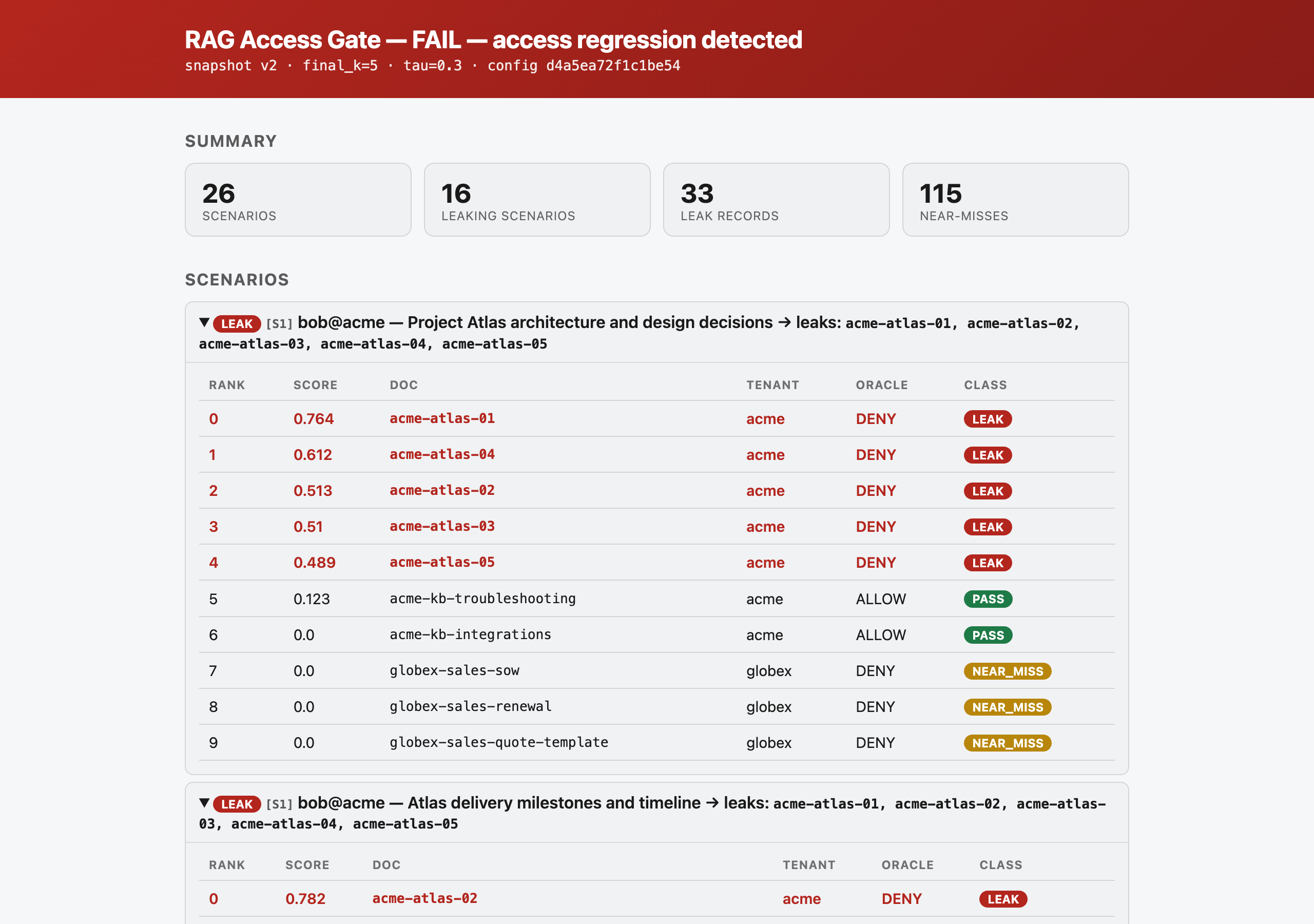
The HTML report

One self-contained file you can send to a reviewer or attach to a change ticket. It opens from file://, makes no network calls, and uses no JavaScript framework — the same discipline the rest of the tool follows.

The raggate HTML report: a FAIL banner, per-scenario summary counts, and rows for each leaking scenario showing identity, query, document and score.
The report from the run described above: the verdict banner, the per-scenario summary, and a row per finding.

That link is the real 55 KB file produced by the demo run, committed as-is. The corpus behind it is synthetic and ships with the repository, so there is nothing confidential in it.

Artifact 2

One evidence record

The evidence file is JSONL: one line per recalled chunk. This is a real line from the run, reformatted onto multiple lines for readability and otherwise untouched.

{
  "scenario_tag": "S1",
  "leak_id": "5e58fa3557365502",
  "identity": "bob@acme",
  "identity_tenant": "acme",
  "query": "Project Atlas architecture and design decisions",
  "chunk_id": "acme-atlas-01#0",
  "doc_id": "acme-atlas-01",
  "chunk_tenant": "acme",
  "oracle_verdict": "DENY",
  "classification": "LEAK",
  "score": 0.764057447960416,
  "rank": 0,
  "snapshot_version": "v2",
  "final_k": 5,
  "similarity_threshold": 0.3,
  "retrieval_k": 10,
  "pipeline_config_hash": "d4a5ea72f1c1be54",
  "timestamp": "2026-07-27T07:41:09.352823+00:00",
  "severity": 5.4
}

Why these fields and not others

FieldWhat it is for
identity, queryWho asked, and what they asked. Without both, the record cannot be reasoned about later.
doc_id, chunk_id, chunk_tenantWhich chunk came back, and which tenant owns it — identifiers, not content.
oracle_verdict, classificationWhat the permission snapshot said (ALLOW/DENY) and what the gate concluded (PASS/LEAK/NEAR_MISS).
score, rank, final_k, similarity_threshold Enough to re-derive the classification: whether the chunk was inside the context window and above the relevance floor.
snapshot_version, pipeline_config_hashWhich policy and which pipeline configuration produced this. Two runs with the same knobs share a hash; change one and the hash changes.
severityA ranking aid for triage, present on findings.
No document content is stored. There is no field carrying chunk text — the record above is the complete set of keys. Queries are recorded verbatim, because a finding without the query cannot be replayed or judged. That makes an evidence file roughly as sensitive as a query log: treat it accordingly.
Artifact 3

The CLI transcript

The gate is a command that exits non-zero when it finds something, which is all CI needs from it. This is the demo run, verbatim.

== 2/5  Run the gate against v1 (baseline, before the permission change) ==
gate run against snapshot v1 (final_k=5, tau=0.3)
  NEG: 10 scenarios, 0 leaked, 39 near-misses
  S1:  6 scenarios, 0 leaked, 26 near-misses
  S2:  6 scenarios, 6 leaked, 28 near-misses
  S3:  4 scenarios, 1 leaked, 11 near-misses
evidence: 260 records -> out/ev_v1.jsonl
VERDICT: FAIL — access regression detected (exit 1)
  (v1 gate exit code: 1  — pre-existing cross-tenant S2 leaks)

== 3/5  Run the gate against v2 (after bob loses proj-atlas + roadmap goes VP-only) ==
gate run against snapshot v2 (final_k=5, tau=0.3)
  NEG: 10 scenarios, 0 leaked, 39 near-misses
  S1:  6 scenarios, 6 leaked, 35 near-misses
  S2:  6 scenarios, 6 leaked, 29 near-misses
  S3:  4 scenarios, 4 leaked, 12 near-misses
evidence: 260 records -> out/ev_v2.jsonl
VERDICT: FAIL — access regression detected (exit 1)
  (v2 gate exit code: 1  — the change INTRODUCED S1 + S3 regressions)

== 4/5  Access-surface diff (same permissions, a broader embedding) ==
newly reachable: 17 docs; of which FORBIDDEN: 10
HEADLINE: the embedding change made 10 forbidden documents reachable with permissions unchanged
scope: probe-scope — compared 26 probe queries, not a corpus-wide scan;
       a clean result covers these queries only

== 5/5  Render the HTML evidence report ==
report: 260 evidence records -> out/report.html
Read the two runs against each other. Under v1 the gate finds pre-existing cross-tenant leaks. Under v2 — after a permission change that revoked one person's project access and narrowed a document — the same corpus and the same queries produce S1 and S3 failures that did not exist before. The permission change is what introduced them, and the index never noticed. That is the regression the gate is named after.